



- label News
- favorite 0 likes
There is no single “best garden ladder” for every outdoor task. A ladder that is stable between tree branches may be inconvenient for gutter cleaning, while a lightweight step ladder that is perfect on a patio may sink or rock on wet grass. This guide compares the main garden ladder types and explains how to select, position and inspect them safely.
Important: This is general buying and safety information, not individual advice. Follow the manufacturer’s instructions and the current HSE guidance on ladders and working at height. For chainsaw work, professional tree surgery or significant work at height, use appropriately trained specialists and equipment.
Why garden work needs a different ladder
Outdoor work creates hazards that are less common indoors: grass can be soft or wet, paving can be slippery with moss, borders are uneven, and trees and hedges restrict where the ladder can stand. Wind, rain, fallen leaves, tools and members of the public can also affect stability.
The HSE advises using ladders on firm, level, clean surfaces and securing them to prevent slipping. In a garden, that means choosing the ladder type and its stabilisation method before climbing, rather than placing an ordinary ladder wherever the work happens to be.
Soft ground, slopes and uneven terrain
A standard four-footed step ladder needs all four feet to sit firmly and evenly. On a lawn, slope or rough border, one foot may sink or fail to carry its share of the load. The result can be rocking, sideways movement or a sudden change in balance.
An adjustable tripod ladder has two front legs and one rear leg. The third leg can often be positioned between branches, inside a hedge or on a slightly different level. It is not a licence to use a ladder on steep, unstable or waterlogged ground, but it can solve the geometry problem that makes a conventional step ladder unsuitable.
Working around trees, hedges and borders
Branches can prevent a straight ladder from standing in the position needed for pruning. A tripod or orchard ladder has a narrower upper profile and can be positioned closer to the canopy. For hedge cutting, the important features are stable footing, a safe standing position and the ability to move the ladder without carrying a running tool.
Never work from a ladder while using a chainsaw. A chainsaw, pole saw or powered hedge cutter can create forces and hazards that exceed what a ladder is intended to support. Use ground-based tools where possible or engage a competent tree-care professional.
Weather exposure
Aluminium is naturally resistant to corrosion, but the ladder still needs to be dried, cleaned and stored correctly. Water, mud, moss and leaf litter reduce grip. Wind can turn a tall ladder into a sail, especially when handling hedge trimmings, sheets or other large materials.
Stop if wind, rain, ice, poor visibility or another condition makes the ladder unstable or the work difficult to control. Outdoor equipment should be inspected after transport, impact and exposure to conditions that may cause deterioration.
Types of garden ladders compared
| Type | Typical reach | Stability on grass | Best for | Main limitation |
|---|---|---|---|---|
| Tripod ladder | Approx. 3–5 m | High when correctly positioned | Trees, hedges and fruit picking | More specialist and usually more expensive |
| Step ladder | Approx. 2–4 m | Moderate on firm ground | Low-level garden work and painting | Four feet need a stable base |
| Extension ladder | Approx. 4–8 m | Low unless secured | Gutters and high access | Needs suitable support and securing |
| Telescopic ladder | Approx. 2–5 m | Depends on surface and design | Storage-limited, mixed tasks | Correct locking and setup are critical |
| Combination ladder | Approx. 2–5 m | Moderate to high in approved modes | Versatile garden and maintenance work | Incorrect configuration is dangerous |
| Orchard ladder | Approx. 2–4 m | Good on suitable ground | Fruit trees and narrow canopies | Less general-purpose than a step ladder |
The heights and prices in this table are broad buying-guide ranges, not guarantees. Always use the manufacturer’s stated working height, standing height and configuration limits.
Tripod Ladder: The specialist choice for trees and hedges
The third leg is the defining feature of a tripod ladder. It can allow the ladder to stand where a conventional stepladder would rock, including between branches or at the edge of a border. Many tripod garden ladders also have adjustable legs, allowing the user to compensate for modest changes in terrain.
Tripod stability depends on the ground, leg adjustment, spread and user behaviour. The rear leg must be fully deployed and locked, all feet must be supported, and the user must remain within the permitted standing area. Do not use a tripod ladder on a slope that exceeds its instructions or treat it as a substitute for a scaffold or MEWP for prolonged work.
Step ladder: versatile on firm ground
A professional aluminium step ladder is a good all-rounder for patios, paths, sheds and other firm surfaces. It is portable and quick to open, making it useful for hanging baskets, checking a roofline, painting a shed or reaching a light fitting.
On grass, a step ladder may need a suitable stabiliser or a different work position. Do not level it with loose bricks, boxes, timber offcuts or improvised packing. HSE guidance recommends proprietary levelling devices where levelling is needed.
Extension or leaning ladder: gutters and high access
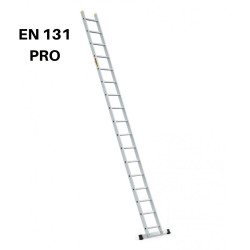
An extension ladder is useful for accessing gutters, fascia and higher points, but it provides a narrow work position and needs a suitable support. It must be set at the approximate 1-in-4 angle and secured against slipping. Do not lean it against fragile gutters, glazing, plastic surfaces or unstable branches.
If the task involves cleaning an entire elevation, repeated sideways movement or forceful scraping, a tower or platform is usually a better choice. A long ladder is not automatically safer because it reaches higher.
Telescopic ladder: compact storage
A telescopic ladder can be attractive for occasional garden use because it stores in a small space. Before every use, check that every locking mechanism is fully engaged and that the product is approved for the intended configuration. Keep the ladder on a firm, level surface and do not assume that compact storage means safe use on soft ground.
Combination ladder: multi-mode flexibility
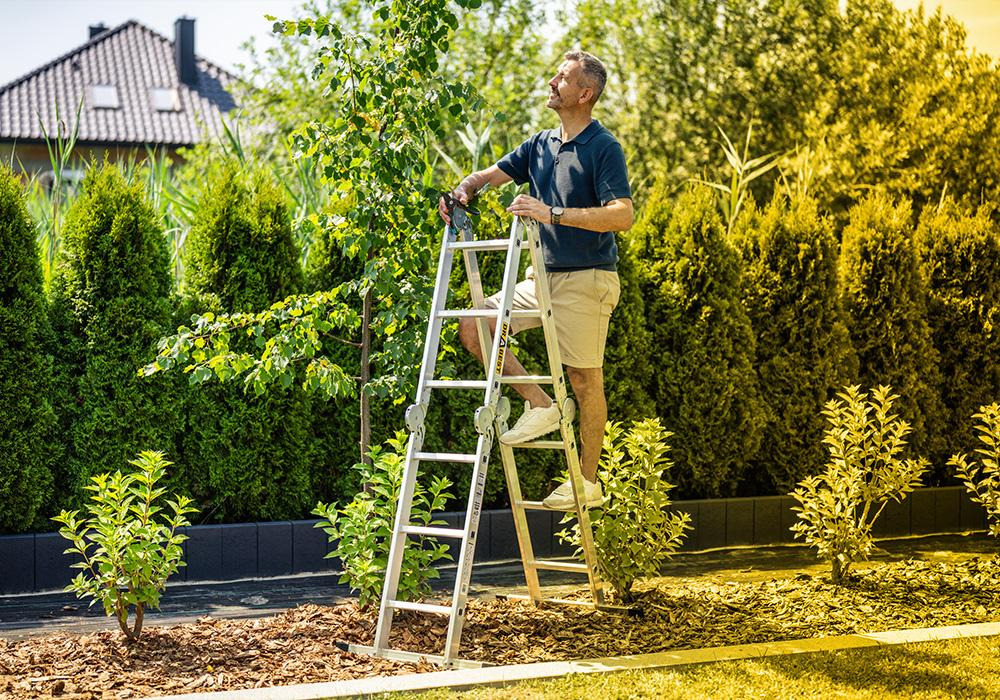
A combination ladder can work as a leaning ladder, stepladder or another approved configuration. It can be a cost-effective option for a household with mixed needs, provided the user follows the manual precisely.
Never create a makeshift platform by placing a board across a ladder. Use only a platform configuration designed and tested by the manufacturer. Lock all hinges, hooks and sections before climbing.
Orchard ladder: narrow profile for fruit trees
An orchard ladder is designed for work among branches. Traditional versions are often narrow and tapered, while modern versions may use aluminium. The shape helps the user position the top within a canopy, but it does not remove the need for firm footing, inspection and a safe work method.
Which ladder for which garden job?
| Garden job | Recommended starting point | Key feature or control |
|---|---|---|
| Small tree pruning | Tripod or orchard ladder | Adjustable third leg and firm footing |
| Fruit picking | Tripod or orchard ladder | Narrow profile and stable standing position |
| Hedge cutting | Tripod or professional step ladder | Stability and safe tool handling |
| Gutter inspection | Secured extension ladder | Correct angle, top support and stabilisation |
| Gutter cleaning | Extension ladder only for short, controlled work | Consider a ground-based pole or platform for longer work |
| Fence or shed painting | Step ladder, platform step or hop-up | Easy repositioning and reduced overreach |
| Hanging lights or feeders | Step or telescopic ladder | Lightweight access and three points of contact |
| Large exterior work | Podium, scaffold tower or MEWP | Guarded work platform and planned access |
Garden ladder safety on soft ground
Stabilising a Ladder on grass, soil and gravel
HSE guidance says ladders should be used on firm, level, clean surfaces. Grass and soil do not automatically meet that description. Before positioning a ladder, remove leaves and loose material, check for holes and roots, and assess whether the surface will support the feet without sinking.
A board or proprietary ground support may help distribute load where the manufacturer permits it, but it must be stable, level and suitable for the ladder. Do not use loose boards, bricks or blocks as improvised levellers. On a steep, wet or unstable bank, choose another access method.
Anti-Slip feet, stabiliser bars and ground supports
Anti-slip feet improve grip but do not guarantee that the ladder cannot move. A stabiliser bar can widen the base, while a proprietary ladder leveller can address a modest difference in ground level. Adjustable tripod legs can help on uneven terrain within the product’s limits.
The 1-in-4 rule outdoors
For a leaning ladder, the base should be approximately one unit out for every four units of vertical height, creating an angle of about 75 degrees. This remains a positioning guide outdoors, but the ground and top support must also be suitable.
Budget guide: garden ladders by price range
The ranges below are indicative buying budgets, not live quotations. Product price varies with height, material, certification, stabilisers and delivery.
| Budget | Likely option | Suitable use |
|---|---|---|
| Under £100 | Basic professional step ladder or extension ladder | Low-level work and occasional access |
| £100–£200 | Combination ladder, telescopic ladder or better step ladder | Mixed garden and maintenance tasks |
| £200–£400 | Entry-level specialist tripod or robust platform | Regular tree, hedge or outdoor work |
| £400–£800+ | Premium adjustable tripod or specialist access equipment | Frequent professional garden and orchard work |
Frequently Asked Questions (FAQ)
What are the best gardening ladders?
For tree pruning, fruit picking and hedge work on suitable uneven ground, a tripod or orchard ladder is often the specialist choice. For general garden jobs on firm ground, a professional aluminium step ladder is usually more versatile. The best option depends on the task, terrain, duration and user.
Can I use a normal ladder on grass?
Only if the ladder can be placed on a firm, level and stable base and secured against slipping. Wet or soft grass may allow feet to sink or slide. Use a suitable proprietary support or choose different equipment; do not improvise with loose bricks or boxes.