



- label News
- favorite 0 likes
There is no single height at which UK law automatically changes a ladder into an illegal piece of equipment. The Work at Height Regulations 2005 require employers and other duty holders to assess the task, select suitable equipment and use the hierarchy of controls: avoid work at height where possible, prevent falls where it cannot be avoided, and minimise the distance and consequences of a fall where necessary.
This guide compares ladders and scaffold towers, explains the practical “upgrade path” between them and gives a job-by-job framework for choosing the right access equipment. It also covers podium steps, hop-up platforms, multi-purpose ladders, costs, training and the standards to look for when buying or hiring.
Important: This is general information, not legal advice. Requirements depend on the task, workplace and equipment. Check the current HSE working at height guidance and obtain competent advice for higher-risk work.
Ladder, Scaffold Tower or Something in Between?
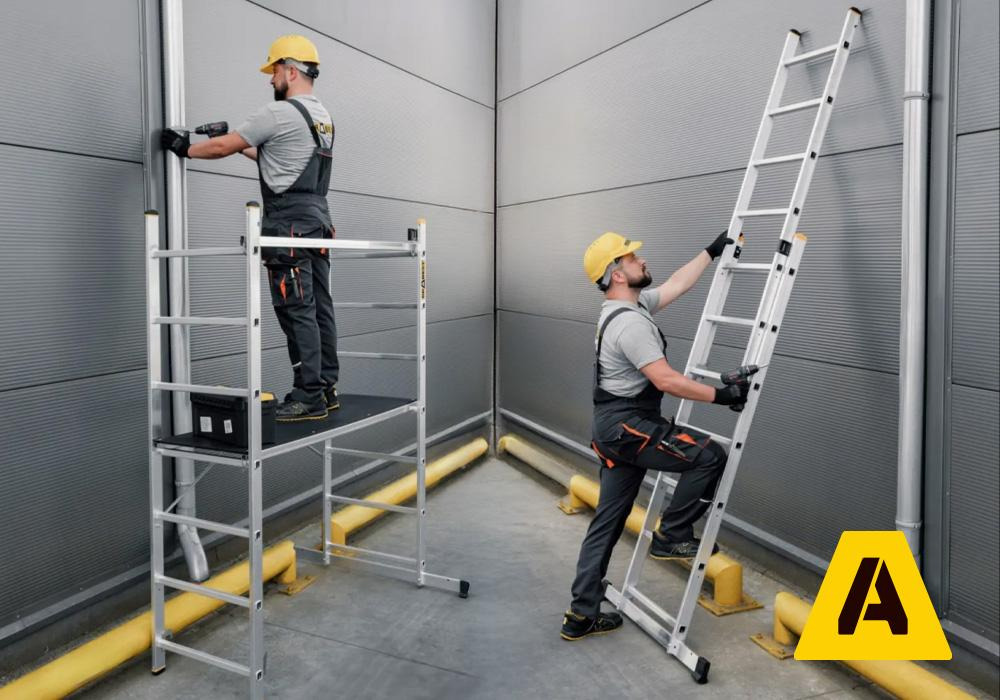
The choice is not always “ladder or full scaffolding”. A ladder is quick and portable, but gives the user a narrow standing position and limited support while working. A scaffold tower takes longer to assemble, but provides a level platform, guardrails and room to work. Between those two options are podium steps, platform steps, hop-up platforms and multi-purpose ladders.
Quick Overview: What Each Option Gives You
| Feature | Step ladder | Podium steps | Hop-up platform | Multi-purpose ladder | Scaffold tower |
|---|---|---|---|---|---|
| Main benefit | Fast access for short tasks | Guarded, stable low-level platform | Compact low-level standing area | Several configurations in one unit | Large guarded working platform |
| Typical use | Inspection, light maintenance | Decorating, fit-out and indoor work | Low-level picking and maintenance | Flexible domestic or trade work | Exterior work and prolonged tasks |
| Guardrails | Usually no full guardrail | Yes, according to design | Usually no | Usually no full guardrail | Yes, with toe boards as required |
| Portability | Very high | High | Very high | High | Moderate |
The “Upgrade Path”
Think of access equipment as a progression based on risk and the way the work is performed:
Step stool → step ladder → platform step → hop-up platform → podium steps → multi-purpose ladder in an approved platform configuration → scaffold tower.
The sequence is not a legal checklist and it is not based on height alone. It is a prompt to ask what the task requires. As the work becomes higher, longer, more forceful or more exposed, move towards equipment that gives greater stability and collective fall protection.
An upgrade can also be sideways rather than upwards. For example, a low-level decorator may not need a tower but may be safer and more productive on a podium. A maintenance worker who needs several short visits around a building may prefer a properly selected professional combination ladder. The best equipment is the one that controls the actual risk without introducing unnecessary handling or setup hazards.
When a Ladder Is the Right Choice
Ladders are not banned in UK workplaces. HSE says that a ladder can be used where a risk assessment shows that higher-level fall protection is not justified because the task is low risk and short duration, or because existing workplace features cannot reasonably be altered.
Short Tasks Under 30 Minutes
HSE uses 30 minutes as a practical guide: if a person needs to stay on a leaning ladder or stepladder for more than about 30 minutes at a time, alternative equipment should normally be considered. This is not a universal legal time limit. It does not make a risky five-minute task acceptable, and it does not mean that every 31-minute task has exactly the same answer.
Duration should be considered with frequency and fatigue. Repeated short climbs, moving a ladder many times or working in an awkward position can make a task unsuitable even when each individual action is brief.
Quick Access, Inspection and Light Maintenance
Examples that may suit a professional step or leaning ladder include:
- checking a fitting or smoke detector;
- replacing a light fitting where the work is brief and controlled;
- accessing a gutter for a short inspection;
- taking a measurement or completing a visual check; and
- carrying out a small, light repair without applying significant force.
The ladder still needs to be correctly selected, inspected and positioned. Keep tools in a belt or holster, avoid carrying bulky items while climbing and maintain three points of contact wherever possible.
When You Should Upgrade to a Scaffold Tower
A tower scaffold is often the better choice when the person needs to work from a stable, level platform rather than climb and balance on a narrow ladder. It provides collective protection through guardrails and can reduce overreaching, although it is not risk-free.
Tasks Longer Than 30 Minutes
Longer work is a strong reason to compare a ladder with a tower, podium or other platform. Painting, installing services, repairing cladding and repeated fitting work can involve extended standing, frequent movement and two-handed activity. A platform can reduce fatigue and make tools and materials easier to manage.
The decision should still be based on the complete risk assessment. A tower must be assembled, inspected, used and moved correctly; it is not automatically safer if it is erected on unsuitable ground or altered without authorisation.
Head-to-Head Comparison: Ladder vs Scaffold Tower
| Decision factor | Ladder | Scaffold tower |
|---|---|---|
| Safety | Suitable for low-risk work when justified and correctly used | Usually provides stronger collective fall protection, when correctly erected |
| Working height | Often convenient for short access tasks; no universal legal maximum | Manufacturer sets the permitted height and configuration |
| Work position | Narrow, with limited room for tools | Level platform with more room and guardrails |
Risk Assessment: A Simple Decision Test
Before selecting a ladder or tower, ask:
- Can the work be done from the ground?
- If not, what equipment prevents a fall most effectively?
- How long will the worker remain at the work position, and how often will the task be repeated?
- Can the equipment stand level, be secured and be accessed safely?
- Are the user, tools, materials, weather, electricity, traffic and people below controlled?
- Can the equipment be assembled, inspected, used and dismantled by competent people?
If the answers expose a substantial risk, upgrade the access method before work begins.
Frequently Asked Questions
Is a scaffold tower safer than a ladder?
Often, yes, for prolonged or two-handed work because a tower provides a level platform and collective protection such as guardrails. It is only safer when correctly selected, assembled, inspected and used. A badly erected tower can be dangerous.
When should I use scaffolding instead of a ladder?
Use a tower, scaffold or another platform when the task is prolonged, forceful, difficult to secure, requires both hands for sustained work or presents a fall risk that a ladder does not adequately control. The risk assessment, not a single height or time threshold, makes the decision.
Do I need scaffolding to paint the outside of my house?
Not automatically. A small, low-risk touch-up may be possible from a correctly secured professional ladder. A full exterior repaint generally benefits from a tower or scaffold because it involves repeated movement, longer duration, tools, materials and potential overreach.
Summary: Making the Right Call
Choose a ladder when the task is genuinely low risk, light, short and easy to carry out from a stable, secured position. Choose a podium or hop-up when you need a better standing surface for low-level work. Choose a scaffold tower, scaffold or MEWP when the job is prolonged, forceful, spread across an elevation or requires a guarded platform.
The upgrade decision should be based on the task rather than a slogan or a single number. Work at height must be planned, the equipment must be suitable and users must be competent. Inspect ladders before use, assemble towers according to the manufacturer’s method and stop work when conditions change.
Official guidance and further reading
- HSE: Safe use of ladders and stepladders
- HSE: Work at height frequently asked questions
- HSE: Tower scaffolds
- The Work at Height Regulations 2005
This guide is for informational purposes. Always refer to current HSE guidance and seek professional advice for your specific situation.